
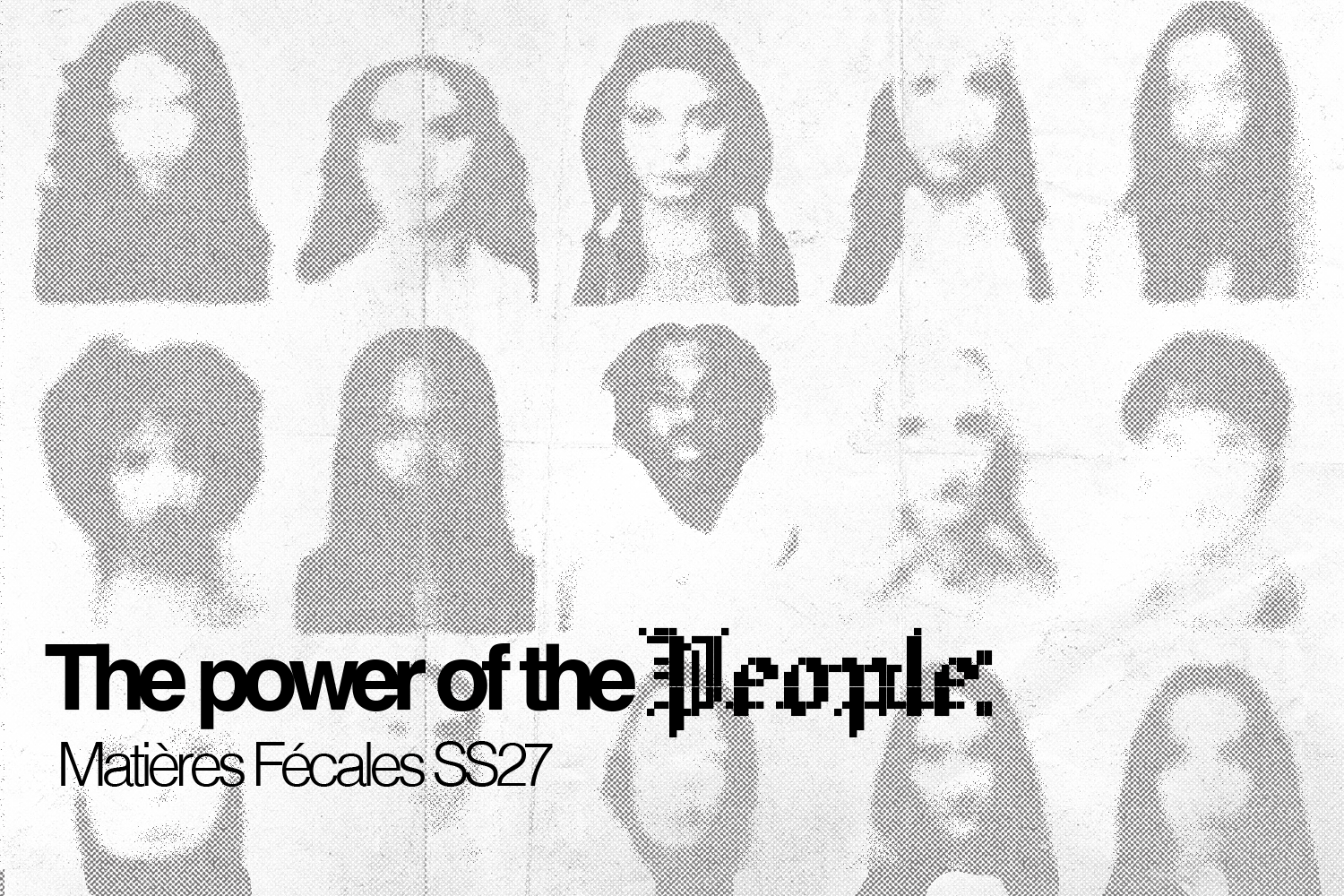

Matieres Fecales closed out the first day of Paris Fashion Week with a defiant bang, showcasing an ode to the people. ‘The 99 Percent’ is the sequel show to ‘The 1 Percent’ which debuted in Paris for F/W 26. The two part collection functions as an examination of founders’ Hannah Rose Dalton and Steven Raj Bhaskaran’s upbringings. The duo’s takes on the aesthetics of power, wealth inequality, and late-stage capitalism was created through the lens of Hannah Rose’s upbringing. This year, it’s Steven’s turn. The first fashion show to ever be held at Place de la Republique, a historic Parisian square known as a rallying point for protest and social reform, ‘The 99 Percent’ is a tribute to those who are pushed aside in the Eurocentric fashion industry and the world at large. Featuring a landmark 99 models of color in 99 looks, the show was divided into three chapters.
We commence with Family, focusing on Steven’s upbringing in Montreàl. A tribute to the vast spectrum of immigrants and various faiths he grew up surrounded by, the show opened with models carrying swaddled children, and featured many Matieres Fecales signatures. Gentle draping, frayed, distressed hems, pleated and gathered sheers in an achromatic palette, transitioning into vibrant reds, oranges, and pale pinks. Kurtas and dresses in crisp cotton decorated with subtle cross motifs were interspersed with veiled men, a reversal of the patriarchal sanctions imposed on women across many religions. Part One of the show was closed by Steven himself with his mother, Grace, sister, Shandeal, and niece, Vihanna. The emotional palpability of the moment is intense, a testament and tribute to the insurmountable work and sacrifice of immigrant families in pursuit of security, better livelihoods, and dreams.
Part Two, titled ‘Tribes’, also referred to as the “protest section”, celebrates the alternative community both members of the design duo found refuge in as young adults. Enveloped in smoke and strobes, models sported body augmentations, spikes, feathers, colored contacts, and outrageously long nails as they stormed the Republique. Callouts to goth, punk, and metal subcultures danced with distressed and embossed denim. The kurta cross motif was carried through in the skimpiest of bandage tops, featured in yellow python and black leather. Classic alt full-leather looks mingle with balaclavas and floating crepe fabrics, birthing a style that is delicate yet dangerous, all Matieres Fecales. The male body diversity, arguably seen even more rarely than their female counterparts on the runway, was a welcome addition to Part Two. To longtime fans of the brand, the widely featured body mods serve as a fond recollection to the brand’s early days of virality for their skin prosthetic heels and alien-esque extreme modifications. The Tribe section also featured direct political messaging concerning the social issues surrounding the massive immigrant community in France. A male model is veiled with the tricolore emblazoned with the word ‘RESIST’ in large black lettering, which was repeated various times throughout this section. Regardless of specific subculture, BIPOC members of alternative communities occupy the space between a unique rock and a hard place. Drawing criticism from both typically traditionalist family and extremist members of said subcultures, alternative people of color often end up going against the status quo of the communities they were born into, as well as the ones they hoped to find refuge in, creating a separate niche where unconventional takes on their home cultures blend and melt with alternative design codes. Regardless of internal discourse, the love for this community runs deep, as it is often the first place many children of color experimented with self-expression, and found a place to process the intricate feelings that come with existing in a space that was not built for them.
In a world where power structures are dismantled, where everyone is truly equal, and nobody is suffering in the name of another’s gain, who do we worship? What do we aspire to? The final part of The 99 Percent is titled ‘The Gods’, and while it doesn’t necessarily endeavor to answer these questions specifically, it does invite the viewer into a world where cultural opulence takes center stage, and traditional craft is rightfully recognized as a cornerstone of the modern fashion industry. The Gods is opened by Mounia Orosemane, one of the first black couture models, and a personal favorite of Yves Saint Laurent. She floats down the runway in a black tulle gown, full skirt trailing behind her, giving a symbolic impression of the barriers she broke in fashion. Her veteran status as a model is dazzlingly apparent, the perfect opening to the final chapter celebrating the power and perseverance of the people. Here is where Matieres Fecales’ avant-garde handiwork shines. Trompe l’oeil feathers, drop waist evening gowns, dramatic shoulders and high necklines. Dalton and Bhaskaran sought to showcase textile mills and practices that are often overlooked in the European fashion industry, the duo spoke of a textile mill in Burkina Faso they worked with to create Look 81, a cream gown with asymmetrical shoulders and the allover gathers that are featured widely throughout the collection. Also highlighted is Steven’s Tamil heritage, drawing on centuries-old traditions from one of the most technically rich fabric and craft regions in the world. Gorgeous, high fashion takes on saris: close fitted and blouseless in sheer nude fabric with allover embroidery, a drop waist gown in petal pink adorned with silver beadwork and fringe. Select models wear sindoors and gothic face paint, an enchanting union of heritage and subculture, calling back to the themes of Part Two. Look 92 in particular drives home the highlighting of couture tradition, calling to mind an image of a phoenix rising from the ashes. The couture section ends with two models carrying life-size sculptures of white male billionaires designed by Sarah Sitkin, longtime Matieres Fecales collaborator. The billionaire effigies are wearing the dollar bill masks featured in The 1 Percent, signifying the redistribution of power from a select few to the masses.
The irony of creating a collection dedicated to those who are oppressed by current power structures, and staging it in a blocked off public square for those who are currently holding the majority of the world’s wealth, was not lost on Dalton and Bhaskaran. The duo partnered with fashion personality and commentator Lyas to invite 500 guests from his explosive La Watch Party series to view the show in person, but many online wondered if this was ‘enough’. In fashion, one must play the game to earn the profit. Finding the balance between honoring those who truly make the world go around, and appealing to those who hold the keys to the kingdom is a skill that even the most prolific designers struggle with. In recent years, fashion has felt increasingly tone deaf against the backdrop of global conflict, genocide, income inequality, and climate crisis. Brands have created a parade of beauty without substance, to be enjoyed by only a select few, while the thousands who work to bring a collection to reality, and those who dream of breaking into fashion, rarely get to enjoy the fruits of their (oft underpaid) labor. To be a part of an industry that buries its head in the sand in the name of preserving the bottom line can feel maddening and disheartening. Matieres Fecales doesn’t shy away from the irony of their position, yet does not seek to justify it. In our age of the digital empire, truly thought provoking collections and shows have become increasingly rare. Regardless of the viewer’s interpretation of the unique niche Matieres Fecales has created, the craftsmanship, message, and showmanship of The 99 Percent was a refreshing, defiant, and proud end to the first day of Paris Fashion Week.