
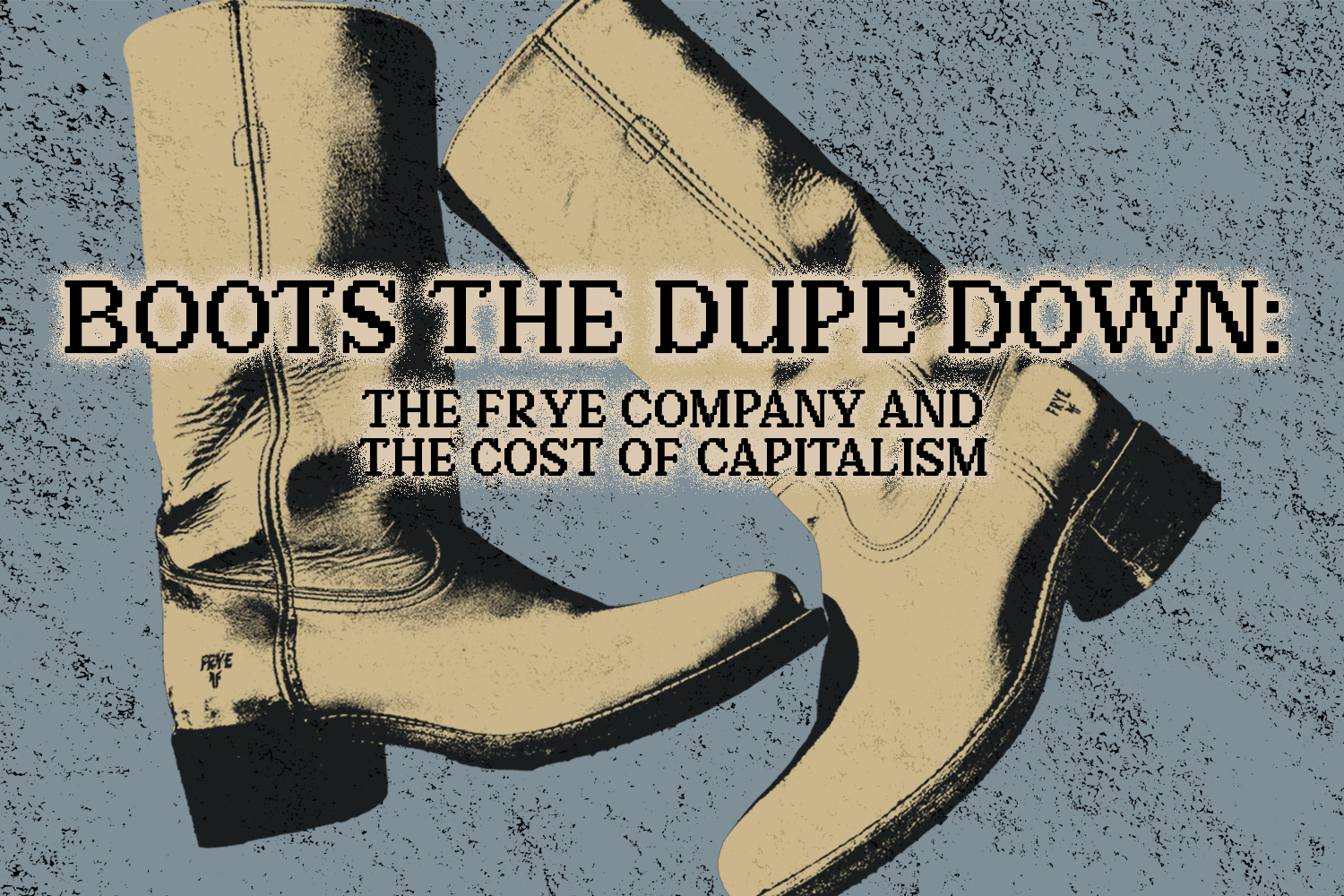

I’m sure you’ve seen them. From Instagram photos to Pinterest boards to the feet of art school classmates, Frye boots are everywhere. Specifically, the Frye Banana Campus Boot.
For those that are unfamiliar, The Frye Company is a leading American shoe manufacturer, known for their high-quality leather boots. They claim to be the longest continuously-operating shoe company in America, founded in 1863 by John A. Frye in Massachusetts. Many modern boot silhouettes, like the iconic harness boot, are inspired by Frye’s original designs from the 1960s. Made to last for decades, the designs were greatly inspired by the American West and the lifestyle of working Americans in the 1940s, 50s, and 60s.
In the past few years, we’ve seen a resurgence in popularity of a specific Frye boot–the Banana Campus. They’re structured, knee-high boots made out of a light, yellowed leather. The round toe and chunky heel set them apart from cowboy boots, but they maintain a feeling of nostalgia and history. They’re undeniably gorgeous – with their 60s silhouette and subtle western flair.
But here’s the catch. On the Frye website, these boots are priced at a whopping $489 dollars. To some, this is an unimaginable sum to pay for a pair of shoes. To others, it’s a hallmark of quality and investing in a piece that will last for generations. A sort of cult following has developed around finding both vintage and lightly used Frye boots online, with some consumers heading to Poshmark, Depop, and Ebay, or even sites specific to collecting vintage Frye. Though these sites are normally known for pricing used items lower than their retail value, for Frye boots, the opposite is true. Boots are sold for up to $1,200, ranging based on condition and rarity of style.
To quickly disclose my personal bias – I am a proud owner of multiple pairs of Frye boots, some secondhand vintage and others bought new. I wear my Banana Campus boots with pride, but at the same time, I am forced to acknowledge the history and economic implications of the style.
A shoe that was once a symbol of the working class is now a high-end item that, unfortunately, most consumers are priced out of. This notion of capitalist consumerism and style scarcity has forced a product founded on principles of function and longevity to become just another trend in the cycle. Enter: dupe culture.
The Frye boots that you’ve seen are likely not Frye boots at all. Dupes, which offer similar if not the same styles at a much lower price point, are found in stores and all over the internet. The most popular for the Campus boot is the Steve Madden Riggs boot, which is nearly identical, though made with much different material and production.
Another popular, and quite frankly confusing, dupe is the Miranda boot from Frye and Co. (not to be confused with the original Frye Company). There’s much debate online about the legitimacy of Frye and Co. and their association with The Frye Company, if any at all. The newer brand was founded by JCPenney, inspired by the “rich heritage” of the original Frye Company. Their products are meant to be more accessible from a price and availability perspective.
Dupe culture is an issue in itself – one of accessibility and individuality. Dupes are a product of the inequality and scarcity that exists in a world where the average person can’t afford high-quality items at the speed at which the trend cycle moves. If real Frye boots could exist at a price point accessible to the modern working class American, the issue of dupes wouldn’t exist at all. The capitalist system forces us into a position where affordable items aren’t made to last, and the items that last aren’t made affordable.
Of course, there’s really no ethical consumption under capitalism. Whether you’re spending your hard-earned savings on vintage Frye, or buying the much more affordable JCPenney dupe, it’s impossible to not be complicit in systems that are entirely out of our control. Still, it’s important to recognize where the pieces in your closet are coming from, what they were made with, and how they were made. Dupe or no dupe, the style of the shoes on your feet communicate history, culture, and even status. So when you see the iconic Frye silhouette, or maybe even purchase a version for yourself, remember the contexts behind it. And whatever pair you’re wearing – rock those boots with pride.
Words by Avery Melhado