
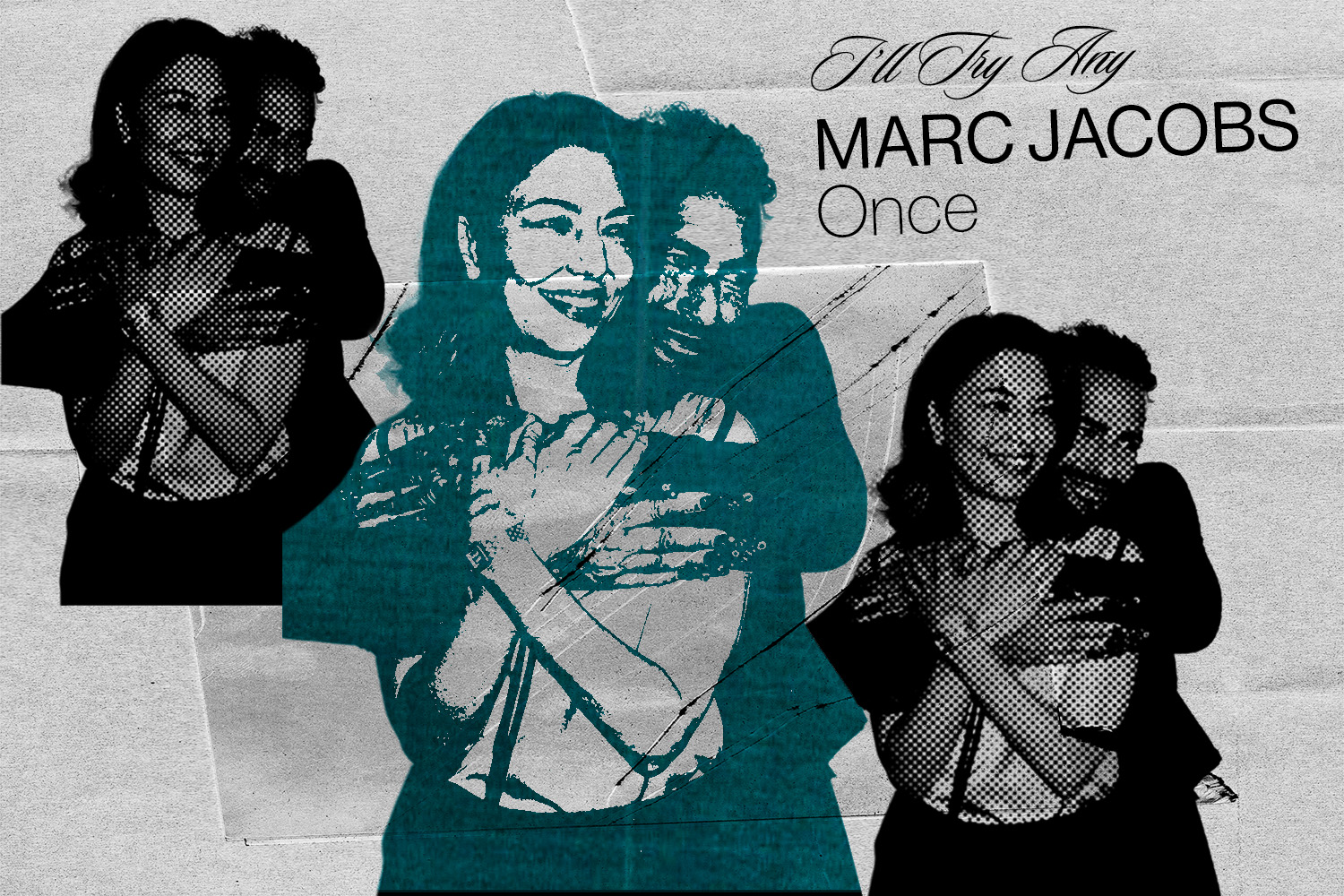

There is a moment, early on in the film, when Marc Jacobs describes his mother brushing black velvet and using the clumps of lint to thicken her eyelashes. It is intimate in a way that makes you feel lucky to hear it, like he knew the exact weight of what he was revealing. Later, you see it echoed on the runway: lashes heavy with glue, deliberately thick and mile-long, theatrically Pattie Boyd-like, reaching toward something so wistful and romantic. Fashion, for him, was always about translation and approximation – a way of getting close to something he understood early on but might never fully gain again. That sense of knowing, of being aware of the gap between where you are and where you need to go, is what sticks with me more than anything else in Sofia Coppola’s documentary. Underneath the softness, the polished silver nails, the silk, and the beautifully lit nothingness, there is a quieter narrative: Marc Jacobs was never just the golden boy. He could’ve lived and died as one.
The film gestures toward the kind of talent that gets labeled quickly: the one to watch, the one who “gets it.” Usually, that story has a second act we all know too well. The golden boy leaves school, hits the real world, and something fails to translate. Taste becomes politics, and the artist either stalls or disappears. But Marc didn’t. The documentary never says this outright, but he understood very early in his career that Parsons wasn’t the destination; it was just one room in a much bigger house. You feel it in the way he discusses his early work at Charivari or the Perry Ellis Grunge Collection – not just as a failure that became legend, but as a risk he was already prepared to take. He knew that playing it safe would never sustain him.
Even later, at Louis Vuitton, you get the sense that he understands the machine he is inside of. He is not consumed by it; he negotiates with it. This is what separates him from the archetype of the burnt-out prodigy. He always had a psychological exit strategy, a way of not letting any single system define the entirety of his identity. It makes one think about how easy it is to be “good” in school, where the rules are clear (while also being easy to break), and how terrifyingly unclear everything becomes the second you step outside of that. Because importance isn’t the same as survival. And survival, to me, is the more interesting story here. What does it mean to carry a voice without that framework? To survive not just creatively, but industrially?
The film doesn’t answer that, but Marc does just by existing within it. He is calm but not passive, surrounded by a team that seems to read his mind, yet never fully dependent on them to define his vision. That steadiness is what Coppola is really filming, even if she dresses it up as something more ethereal. Because yes, this is still very much her world: soft light, drifting models, and references to Elizabeth Taylor (because everything always comes back to Liz) or Diana Ross that feel more like ideas than people. Sometimes, this reverence works against the film. It is a love letter where conversations confirm something that already exists rather than building something new. You are not learning Marc Jacobs; you are witnessing Sofia Coppola loving him. It smooths out the edges that might have made the work feel more urgent.
I kept wanting her to push a little more, to ask the question that sits right there: how did you not fall apart? The film brushes against the chaos, the cultural collisions, and the history with icons like Courtney Love, but it merely accepts the importance of these moments rather than interrogating the survival they required. Yet, there are moments where Coppola’s instinct for emotional texture meets something real in him – the loneliness of being looked at but not understood, or the quiet admission that a designer’s work is “just a fantasy.” The way identity shifts depending on where you are and what you are wearing, how one black t-shirt fits differently in New York versus in Paris.
He knows what he is making isn’t truth; it’s interpretation. Perhaps that awareness is what kept him from burning out – not believing too fully in any single version of himself. Despite the places where I wish the film pushed further, I can’t dismiss it. It left me thinking less about Marc Jacobs as a designer and more about what it takes to last; to move through systems built to elevate or discard you and to come out with something intact. Watching him, it feels like something you have to decide early. There is always something beyond the room you are currently being praised in, and there is a quiet urgency to find it before that praise runs out.
Words by Lux Paiz
Graphics by Chloe Rhodes