
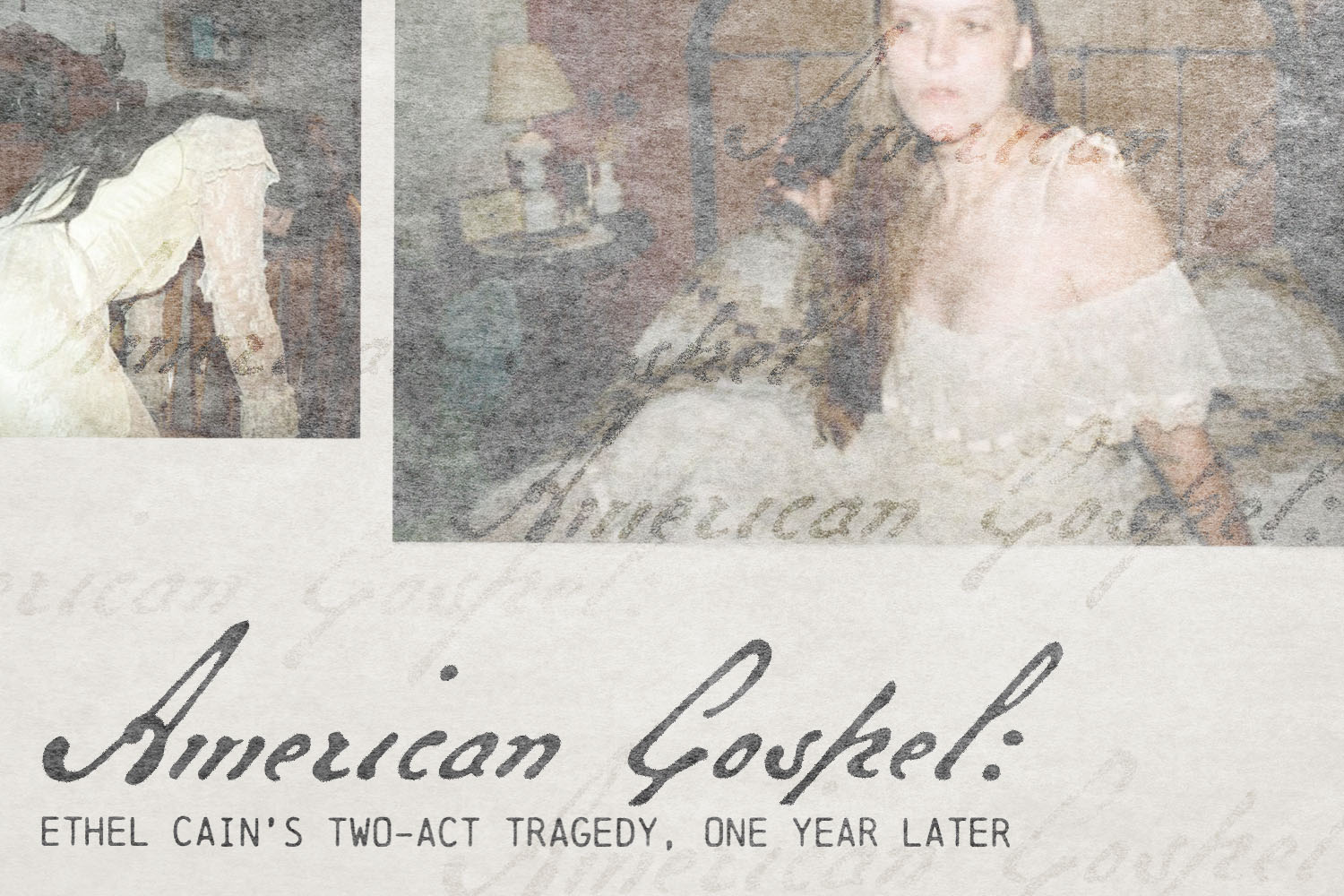

There is a particular kind of grief that comes with watching a story end exactly the way it was always going to end. Not a twist, not a rug-pull, just the slow, inevitable click of a door closing on something you knew, from the first note, was never built to last forever. That is the feeling settling over Ethel Cain’s discography right now. Willoughby Tucker, I’ll Always Love You just recently passed its first anniversary. The Willoughby Tucker Forever Tour, the sprawling, sold-out victory lap that carried Hayden Anhedönia across three continents, finally ended on Saturday after 104 shows. And somewhere in the middle of all that ending, Ethel Cain is more culturally omnipresent than she has ever been. Trending audios, “Ethel Cain coded” character discourse, a running joke that every fandom, no matter how unrelated, seems to contain its own quiet corner of Daughters of Cain. It is a strange, fitting paradox: the era is closing just as the audience is finally catching up to it.
To understand why Willoughby Tucker landed the way it did, you have to go back to 2022 and the album that started it all. Preacher’s Daughter was never just a collection of songs, it was a novel disguised as a tracklist. A full Southern Gothic narrative about a preacher’s daughter fleeing a suffocating Alabama town, falling into the hands of a man who third offers her love and then sells her into exploitation, and ultimately meeting a horrifying, cannibalistic death at his hands. What made it extraordinary wasn’t the shock value of that plot, it was the patience of it. Cain let dread accumulate the way real trauma does: quietly, generationally, and disguised as inheritance. The record opens with the weight of a bloodline and religious duty that doesn’t resolve until its final act, when the character, Ethel Cain, is finally, gruesomely swallowed. A metaphor as much as a plot point, for what happens when generational wounds go unspoken and unhealed.
What elevated Preacher’s Daughter into something closer to literature than an album was Cain’s control of voice. She wrote in first person but never let the character become a simple stand-in for an autobiography. She let the songs breathe as scenes, each one a chapter with its own tense and its own weather. It’s storytelling that trusts the listener to sit in ambiguity, to piece together implication rather than being told outright. That trust is, in many ways, the whole reason a cult following formed around a debut album from an artist recording out of a church basement in Indiana.
Then came Willoughby Tucker, I’ll Always Love You, and with it, one of the more audacious structural choices in recent memory: a sequel that runs backward. Rather than continuing Ethel’s story forward from her death, Cain chose to write the prequel, setting the album in 1986, five years before Preacher’s Daughter begins, and centering it on the teenage romance that haunts the earlier record’s most devastating song, “A House in Nebraska.” It is an album about the before, about first love, about a version of the character who still has a future in front of her, who doesn’t yet know what’s coming.
That choice is what makes Willoughby Tucker such a genius piece of storytelling rather than a cash-grab return to a beloved universe. Cain isn’t just adding lore. She’s forcing the listener to hold two timelines in their head simultaneously: the tenderness of a teenage romance and the knowledge of exactly how badly it’s going to end. Every gentle moment on the record is shadowed by Preacher’s Daughter‘s ending, which listeners already know by heart. Its dramatic irony is used as a compositional tool, the same trick great tragic literature has always used.
Musically, the record softens without losing its teeth. Where Preacher’s Daughter reached for the operatic and the horrifying, Willoughby Tucker leans into something closer to memory itself. Something hazier, more Americana than gothic horror, more slowcore than dirge. Singles like “Nettles” and “Fuck Me Eyes” carried that duality well before the full album arrived: intimate, aching, but never sentimental in a way that would betray what the listener already knows is coming. Critics largely received it as the tender, devastating bookend the character deserved. The sound of watching someone you already know is doomed to fall in love anyway.
What’s happened in the months since has been its own kind of storytelling, one that’s out of Cain’s hands entirely. Deep cuts and once-overlooked tracks have found second lives as trending audios, looping under everything from mundane get-ready-with-me videos to full aesthetic tributes, introducing her catalog to an audience that never lived through the initial Preacher’s Daughter rollout. There’s a specific, recognizable cultural phenomenon at play: the sense that no matter what corner of the internet you’re in, whatever fandom, whatever niche, there is, somewhere, a contingent of Ethel Cain girls who have claimed it as theirs: Southern Gothic. Doomed romance. Transgenerational trauma dressed in gauzy Americana. It’s become shorthand, a whole visual and emotional vocabulary that fans reach for even when they’re talking about something that has nothing to do with her music at all.
That vocabulary found a fresh flashpoint this year with Leviticus, the Adrian Chiarella-directed supernatural horror film that premiered at Sundance before opening theatrically. On its face, the film’s plot of two teenage boys chased by an entity that takes the shape of the person they desire most, has nothing to do with Ethel Cain’s discography. But the internet reached for the “Ethel Cain coded” label almost instantly, and it stuck. It’s not really about the plot mechanics; it’s about a shared emotional register. Repressed queer desire pressed against religious dread. Rural isolation as its own character. Love that curdles into something dangerous because there was never anywhere safe for it to go. That’s the atmosphere Cain built her entire catalog on, and now it’s become a recognizable enough aesthetic language that audiences apply it to stories she had no hand in making. The highest possible compliment for a world-builder.
The Forever Tour, one of the largest and most emotionally loaded live shows an artist like Cain has ever mounted, spanning North America, Europe, and Oceania, has just reached its finale, and there’s a particular kind of mourning setting in among longtime fans. Not just for the tour, but for the sense that this closes out something larger: the two-album arc that gave Ethel Cain, the character, both a beginning and an end. Anhedönia has spoken of this project as the completion of a trilogy’s first chapter, which means what’s ending isn’t just a touring cycle, but the specific narrative that turned a self-recorded church-basement project into one of the defining discographies of her generation.
That’s what makes this moment worth pausing on, rather than just letting it pass. It’s rare for a body of work to close this concisely, with an audience this attentive, at a moment when its cultural footprint is actually still expanding rather than contracting. Usually eras end quietly, mid-sentence, overtaken by whatever comes next. This one is ending on its own terms, with the full arc visible from the outside for the first time. A girl born into a story that was always going to kill her, given, at the very last possible moment, a love story that let her be young first.
Words by Clayton Creech