
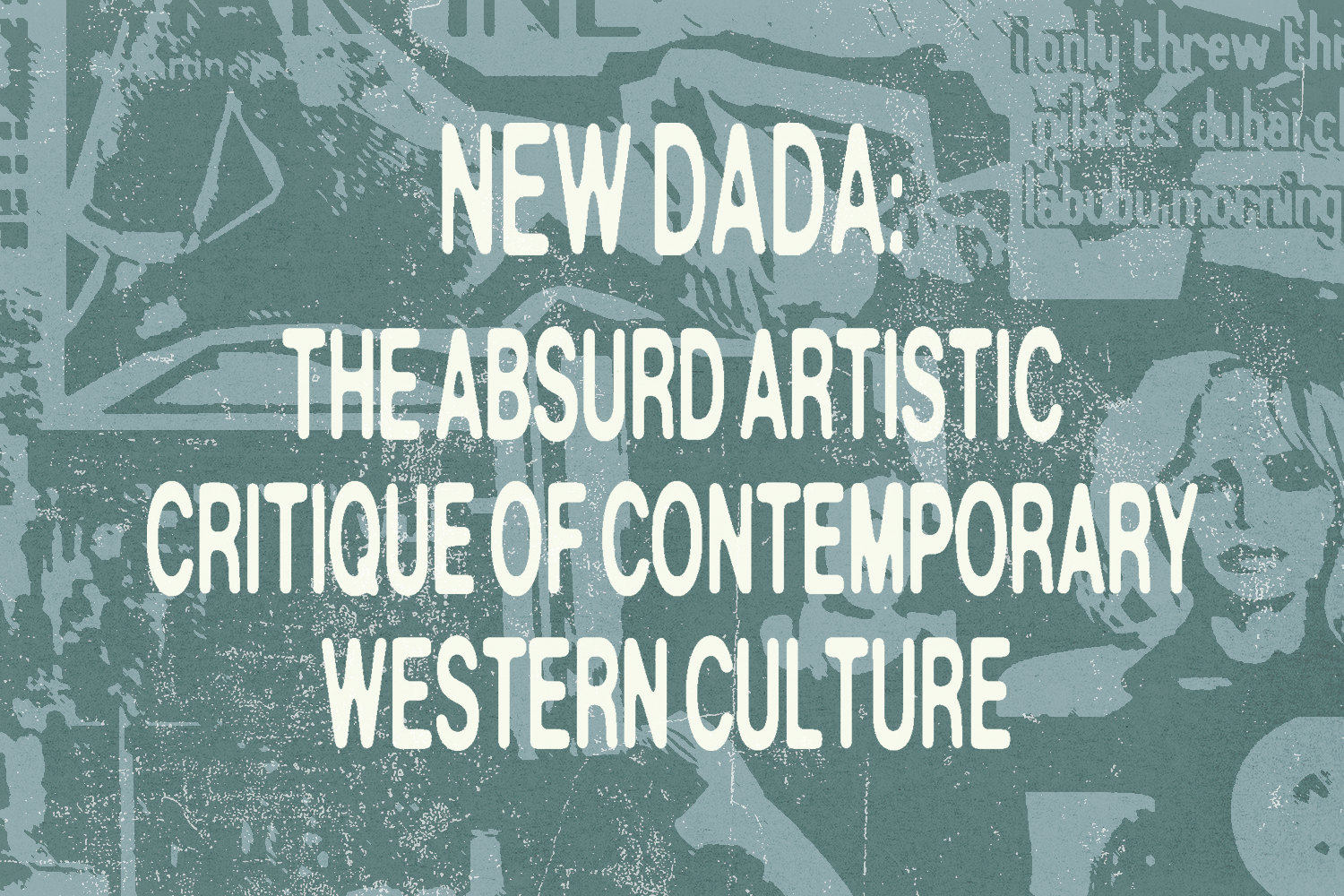

According to the painter and sculptor Hans Arp “Dada existed before Dada.” Dada was an artistic movement that emerged in 1917 in Zurich, Switzerland, invented as a means to escape the terror of a war-torn world. It was a reaction and protest against World War I. The movement then spread from the Cabaret Voltaire in Zurich to Berlin and New York City. Dadaism embraced nihilism, chance, critique, and absurdity. Dada art was resourceful and multifaceted. It was not limited to traditional art-making techniques, as it was a protest against these traditions.
Admittedly, Dada may seem hard to define, and that is because it is. Similarly to the idea of Camp, any definition that is created and applied to Dada will always fall short in encompassing Dada. Just like its creators understood that the history of Dada is irrelevant to understanding Dada, a working definition of Dada is equally non-essential. Obviously this makes sense when you realize that the literal word itself is meaningless. This was by design. The art itself was confusing and cutting-edge. Dada artists could be creating stage-performances, collages, or even extremely conceptual works, like Marcel DuChamp’s Fountain. Dada art could also explore many subjects like free will, the effects of war, gender politics, and negotiating high and low arts. Ultimately the goal of Dadaists was not any call to action, but to critique and poke fun through their artistic output.
Dada existed before itself; therefore, it should surprise no one that I believe it exists after itself. Currently, within the art world, I am noticing a massive resurgence in Dadaist attitudes towards art and art making. Contextually, this would make sense. There is a lot to critique in the world at its current state, and many successful creatives are embracing this in their work. Where originally Dada was critiquing the world at large, I believe this “New Dada” is mainly critiquing western culture. The issues these artists point out tend to center around celebrity, consumerism, and the notion of identity.
Memes register to me as a very Dadaist form of art making, but what is even more Dada is shitposting. Shitposting is usually posting garbage–this can mean a really bad meme, spam posting nonsense, or posting really blurry pictures. Shitposting most recently, and fascinatingly, has evolved into wordsalading. A really timely and useful example of this is the recent rhetoric of “Matcha Pilates Labubu Dubai Chocolate Morning Rave”. To the untrained eye this appears to be complete nonsense. But, if you’re in on the joke, then you can understand that this is a critique of the overwhelming and idiotic consumerist values of the trend-worshipping post-capitalistic west. This form of protesting art adheres to Dada principles by being an assemblage of things, literally words regurgitated onto a screen via instagram’s create mode and then published into the correct algorithms for people who understand the meaning within the absurdity. That is fundamentally Dada. It is no different from Hannah Höch using her kitchen knife to create a collage out of newspaper as a form of political protest. It is a resourceful and democratic media of art making. The words by themselves seem benign and innocuous, but when put all together, it shows the stupidity of these products and how useless they are. The act of shitposting here highlights the vapidity of the things we are being constantly pressured and manipulated into buying.
Even social media personalities themselves are getting wise to the toxic culture that gave them their celebrity. The complicated and mysterious nature of Kim Kardashian and Nadia Lee Cohen’s creative collaborations and relationship can be viewed with a Dadaist lens. If you’re having trouble visualizing this, then let me offer a reading. In their project “Santa Baby”, which was recently released to many negative reviews, the duo could be using societal notions of Kim as a symbol of celebrity and the American consumeristic drive in their creative projects to comment on the failure of our culture. Even using “Santa Baby” the song as the vehicle of their film seems, to me, to be very calculated and intelligent. Kim is playing a personification of American culture. She is singing a song that speaks to hallmarks of American culture: sexuality, traditionalism, and materialism. The video is nonsensical and overwhelming just like the content that we regularly consume. It is littered with symbols that we see used consistently in American media and visual language, it is only the assemblage of all of these at once (just like in the wordsalads) that makes us realize the ridiculousness of all of them individually. Seeing the Virgin Mary, Kim Kardashian, retro cheerleaders, Jesus Christ, bikini-clad blondes, electricians, violence, kitsch, beauty queens, greed, and americana all strewn together in one average American home is so shocking, gross, and eerie to us as an audience because it is confrontational. Kim is America herself leading us through an honest American landscape. Even the nature of the shift of Christmas from a Christ-centric religious holiday to a secular and consumeristic celebration is reflected in the video. The film is an extremely successful critique and commentary of the American culture of the moment. Maybe that is why so many people hated it. It was too real. Many took to the comments rebuking the video and its satanic and/or demonic energy. Like, take a look around, that’s the world we’re living in, and even Kim Kardashian is rubbing our noses in it.
Another artistic duo art making in response to the celebrity industrial complex is Norwegian music duo Smerz. Their 2024 EP, Allina, that they made in partnership with the Paris based Fashion brand All-In Studio, chronicles the fictional story of an invented Y2K-esque popstar named Allina. The content of these songs makes it clear that this project is a satire of the pop-music industry, celebrities and celebrity culture, and arbitrary societal expectations of “feminine” beauty and self expression. The truly Dada spirit of this piece comes through in its embrace of high and low art. The lyrics are hollow, sexy, and completely materialistic, whereas the actual production is experimental, thoughtful, and beautiful. The entire concept itself is very arty. It’s meta: a very conceptual and self aware commentary trying to disguise itself exactly as what it seeks to critique.
With the original Dada movement having found its footing in New York City, I have noticed a new league of creatives with Dadaist sensibilities making waves in the contemporary art scene there. In Cole Escola’s Tony-Award winning play “OH MARY!”, Escola reimagines Mary Todd Lincoln as a wild woman with cabaret star aspirations. It is comedic and absurd but it simultaneously encourages laughter as it confronts issues of repression, performance of identity, and even gender politics. The accessibility of comedy gives this work the low-brow balance that lends it its Dadaist flair. It poses the question of what if Lincoln’s assasination was a good thing for a woman like Mary. In this context, this hypothetical seems ludicrous, but with the identities removed from the characters, it is a much more relevant question to pose. Could it be freeing for a woman living in her husband’s shadow for him to be out of the picture? Escola also appeared in a sketch in Julio Torres’s show Fantasmas. Torres’s works are often very surrealistic and abstracted, but always center around modern existence. Fantasmas offers a critique of modern America and American media through absurdism. Sketches of reality TV stars trapped in a simulated false reality becoming sentient; Ziwe and Alexa Demie playing customer service workers hell-bent on upholding the practices and frustratingly unempathetic bureaucracy imposed by their employers; and Julia Fox gives a wonderful comedic performance as a corrupt Mrs. Claus stating her case in a court battle against the Elves employed and exploited by her and her Husband. Friend and frequent collaborator of Torres, Martine Gutierrez, also plays a performance artist who is so subsumed by her talent agent character that she just functions as an actual talent agent. But, Gutierrez herself is also a central figure in this “New Dada” movement. Her works frequently interrogate the images we see every day. She borrows from the language of modern advertising in her photographic self-portraiture. Present is the principle of resourcefulness that is so familiar to Dada in her use of found materials in her portraits. Her performance piece, #MARTINEJEANS, depicted Gutierrez performing as a cis-female supermodel selling a fictitious jean brand in an advertisement billboard that she created herself. To any passersby this would not even register as a performance or work of art, it would just be another ad, but ultimately it is a commentary on both the concepts of personal identity and collective identity while also functioning as a metacommentary on contemporary marketing and advertisements. So, with this emerging group of talents gaining more well deserved recognition, and a growing embrace of a Dadaist ethos in art, I am beyond excited to see what’s next for the emerging New Dada movement.
Words by Benjamin Pulka
Graphics by Aubrey Lauer